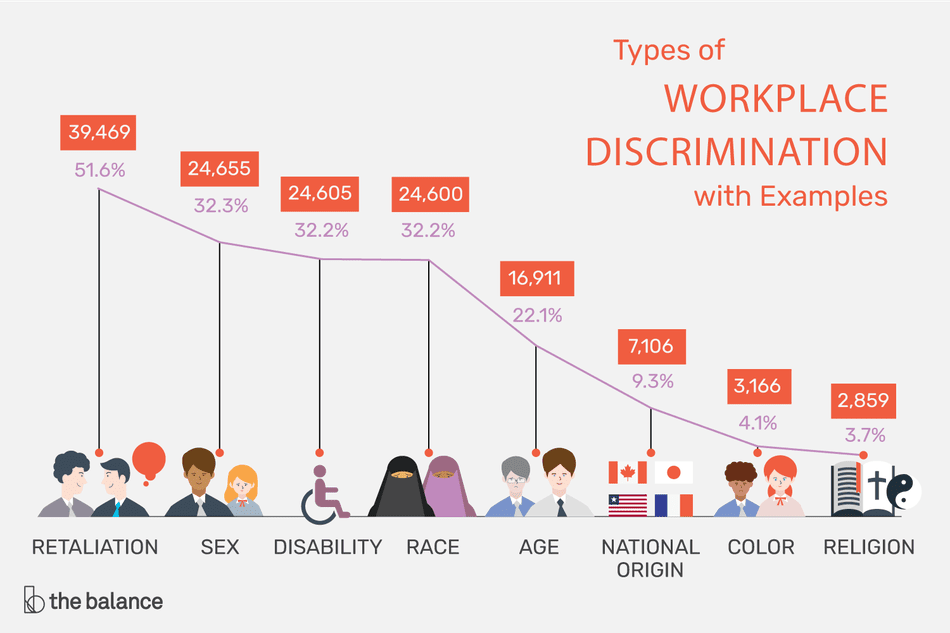
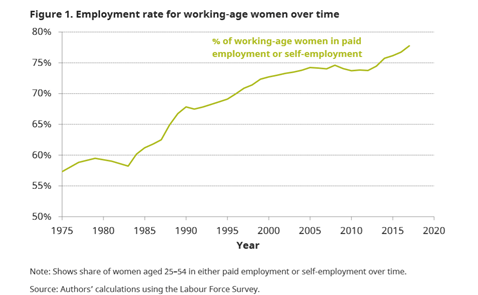
There’s always controversy when discussing women making a living for themselves and in employment. In the past, women always had the role of being a caregiver or staying at home whilst the men had the job of providing for them. A lot has changed, over the last 40 years the rate of employment amongst women has increased from 57% in 1975 to 78% in 2017 (Roantree and Vira, n.d.). Although 1975 is not that long ago, the percentage increase is extremely significant.
We’ve made significant steps forward to try eradicating sexism in general. These include when back in 1918 the first law was passed allowing women (not all) the right to vote (“Women get the vote”, 2019). Since then it seems as though we’ve made major progress when it comes to seeing women as equal to men. So why does the gender pay gap still exists? In 2019 the gender pay gap for all employees in the UK stood at 17.3%, after falling by 0.5% from 2018 (“Gender pay gap in the UK – Office for National Statistics”, 2019). Is it acceptable overall women are getting paid less than men? When looking at the highest paid woman and man, we still see a huge difference! The 10% highest paid man earns a fifth more per hour than the 10% highest paid woman (“Gender pay gap in the UK – Office for National Statistics”, 2019).

Other questions to ask are why are women less likely to get promoted? Why are there more men employed than women? In 2014 it was reported 69% of women were employed compared to 82% of men (Azmat, 2015). This could be due to more men being in higher positions with more authority and therefore recruiting more men than women or is it simply less women want to be employed?
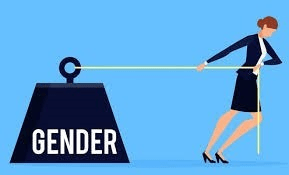
So, we are currently in the 21st century and women are still being discriminated against. Discrimination against women (sexism) is rooted from old fashioned stereotypes. Stereotypes can be defined as “…a fixed, over generalized belief about a particular group or class of people.” (Cardwell, 1996). Stereotypes associated with gender are “a woman’s place is the kitchen” and “women should look after their kids”. You may be reading this thinking those statements are a little outdated. However, most of us have heard these phrases growing up, either directly or indirectly. For example, when buying a gift for a child, the go to options are a doll for a girl and some sort of truck or construction/building game for a boy. If we delve deeper into this, it could come from those same ‘outdated’ sayings where women are primarily caregivers (taking care of the doll/baby) and men go out to work and bring the money home (the truck signifying manual labour). Of course, most of us do not feed into these views consciously, it’s how we’ve been brought up and therefore these views are always in our subconscious.
In the same way women have always been seen as “weak” and “emotional” compared to men. Some ways women are discriminated against at work are not being listened to when proposing ideas, over emphasizing a woman’s physical appearance although it has no effect on the job and unmerited gender labeling, for example labelling a woman as “bossy” or “emotional” however if a man acted in the same way they’d be praised as “headstrong” and “passionate”. So, what causes this prejudice towards women? It could be due to men conforming to normative rules. Normative conformity means people adopt the “normal” set of behaviours associated with a group (McLeod, 2008). Society has always placed women “lower” than men, therefore men may feel the need to uphold these prejudiced views regardless of their morals.
Bandura (1977) stated behaviour is learned from the environment via observational learning, also known as the social learning theory. There are four stages these are: attention, retention, reproduction and motivation. An example scenario in the workplace would be, an employee witnesses a male colleague talk over a female colleague in a meeting and receives no repercussions for it (attention). The employee then goes away with that scenario in his memory (retention). A week later there’s another meeting (ability for reproduction) and this employee wants to introduce a new idea to his boss, however he notices a female colleague starts to speak up and starts to introduce a similar idea to his (motivation) therefore he reproduces the behaviour that was learnt and speaks over her to get his idea across first.
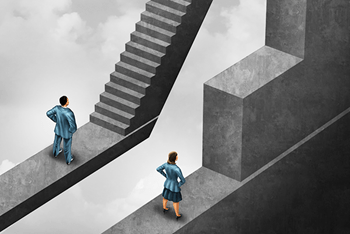
I remember when I had an interview for an apprenticeship in accounting and during the interview the atmosphere was extremely awkward right from the beginning. This was due to the interviewer’s negative body language. When leaving the room at the end of the interview, another candidate was called to be interviewed. The interviewer now had a smile on his face and looked more welcoming overall to the candidate, who was male. This made me think the company wanted to hire a male from the start and I felt I had wasted my time as I was never going to get the position anyway. There could be many reasons for this, the interviewer may have a pre-existing judgment that men are better accountants than women and accounting is a male dominated career. Surprisingly, its not just males who contribute towards sexism. Women in higher ranks also participate towards this. I once took part in an interview workshop and the woman who was leading, said to never disclose your relationship status or if you have children. She shared an experience of hers when she worked in recruitment. Without realising, she believed she had a negative interview with women who had said they recently had got married or they had children. However, she remembers having a positive experience with women who were well in their mid-40s and unsurprisingly men, regardless of their age. This was due to her stereotyping women with being the only carer for their children, as even when the men disclosed they were fathers, there was no link it would affect their work.
I hope one day everyone’s treated equally regardless of their gender or other differences. All of us can contribute towards this goal by trying to not judge others around us and getting to know someone without immediately forming an opinion on them! Let’s all do our part!
- Why do you think sexism still exists?
- Can you think of a time when you have been treated differently because of your gender?
- Have you ever judged someone because of their gender without realising?
 Sabaa Social Psychology